Shutterbugs, This Is Phoenix: Where Concrete Meets Sky in Frame-Worthy Glory
Stepping into Phoenix isn’t just about desert heat and cacti—it’s stepping onto a living canvas. I never expected this sunbaked city to offer such visually striking architecture, each landmark a bold statement against the blue. From angular modern towers to culturally rich public spaces, Phoenix delivers unforgettable photo moments. If you're chasing light, shadow, and skyline, this is where your lens belongs. More than a desert metropolis, Phoenix has evolved into a stage for architectural storytelling, where concrete, glass, and steel dance with sunlight in a rhythm unique to the American Southwest. For photographers, the city offers a compelling blend of nature and design, tradition and innovation—all framed by an endless sky.
Why Phoenix? Beyond the Desert Stereotype
Phoenix is often dismissed as a sprawling desert city defined by highways and heat, but beneath that surface lies a surprising architectural identity. Far from being a mere collection of suburban developments, the city has cultivated a distinctive urban aesthetic shaped by its climate, cultural diversity, and commitment to thoughtful design. The intense sunlight, arid terrain, and dramatic mountain backdrops have pushed architects to innovate—using materials, angles, and open spaces that respond to environmental demands while creating visually arresting forms. This synthesis of function and beauty is what makes Phoenix such a rewarding destination for photographers.
The city’s architectural evolution reflects its growth from a small agricultural hub into a major metropolitan center. In recent decades, Phoenix has invested in civic spaces, cultural institutions, and sustainable design, moving beyond cookie-cutter construction to embrace bold, intentional forms. Buildings are no longer just shelters from the sun—they are sculptural responses to it. Overhangs, courtyards, reflective surfaces, and desert-adapted materials like rammed earth and native stone create textures and contrasts that beg to be captured on camera. These elements don’t just serve practical purposes—they tell stories of resilience, adaptation, and creativity.
What sets Phoenix apart is how seamlessly architecture integrates with the natural landscape. Unlike cities where buildings dominate their surroundings, Phoenix’s most compelling structures often appear to grow from the desert floor. This organic relationship between built and natural environments offers photographers a rare opportunity: to capture not just buildings, but dialogues between human design and the earth itself. Whether it’s the way shadows stretch across a courtyard at noon or how a glass façade mirrors the sky at dusk, the city’s visual language is rich with moments worth framing.
The Iconic Heart: Frank Lloyd Wright’s Taliesin West
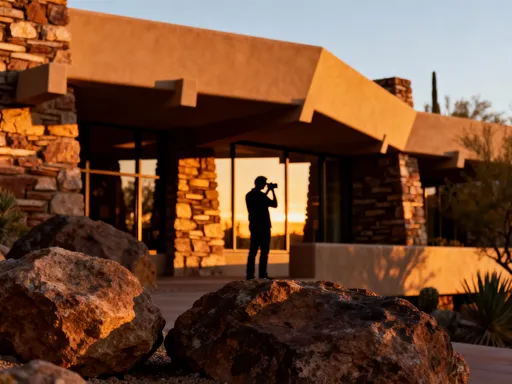
No discussion of Phoenix’s architectural photography would be complete without Taliesin West, Frank Lloyd Wright’s winter home and desert masterpiece. Nestled in the foothills of the McDowell Mountains, this National Historic Landmark is a pilgrimage site for design lovers and photographers alike. Built between 1937 and 1959, Taliesin West exemplifies Wright’s philosophy of organic architecture—structures that exist in harmony with their environment. Here, stone, wood, and glass blend so naturally with the Sonoran Desert that the building seems to rise from the earth rather than be placed upon it.
The site’s visual power lies in its simplicity and precision. Wright used local materials—desert rocks set in concrete, redwood beams, and canvas roofs—to create spaces that breathe with the landscape. The interplay of solid and open, shadow and light, is masterfully orchestrated. At sunrise and sunset, the golden light bathes the structures in warm hues, casting long, dramatic shadows that trace the geometry of the design. These are the moments photographers dream of: when architecture and atmosphere align to create something transcendent.
Visitors can explore the site through guided tours, which provide access to courtyards, living quarters, and the drafting studio—all ideal subjects for composition. For photography, wide-angle lenses capture the scale and integration with the desert, while macro shots reveal the textures of stone and wood grain. The best angles often emphasize symmetry and depth, such as shooting down a covered walkway with the mountains in the background. While drones are not permitted, and some interior spaces restrict photography, the outdoor areas offer endless possibilities. Respecting the site’s preservation rules ensures that future generations can continue to experience its quiet majesty through both eyes and lens.
Downtown’s Architectural Pulse: The Heard Museum & Civic Spaces
In the heart of downtown Phoenix, the Heard Museum stands as a cultural and visual anchor. Renowned for its dedication to Native American art and history, the museum is also an architectural gem in its own right. Its design—blending traditional Pueblo-inspired forms with modern materials—creates a dialogue between heritage and contemporary expression. The façade features textured stucco walls, angular rooflines, and shaded porticos that echo Southwestern adobe architecture, while expansive glass walls invite natural light into the galleries.
Photographers are drawn to the Heard not only for its exhibits but for the way light interacts with its surfaces throughout the day. In the morning, soft eastern light highlights the warm tones of the exterior, while midday sun casts sharp geometric shadows across walkways and courtyards. The museum’s outdoor sculpture garden and kiva courtyard offer intimate framing opportunities, where art, architecture, and desert landscaping converge. Reflections in glass panels, patterns on carved stone, and the contrast between solid walls and open sky provide endless compositional choices.
Nearby, downtown’s civic spaces amplify Phoenix’s architectural narrative. Margaret T. Hance Park, with its lush greenery and urban pathways, frames views of high-rise buildings softened by palm trees and native plants. The park’s bridges, benches, and art installations—like the colorful "Sonic Bloom" sculptures—add layers of visual interest. Public plazas such as Civic Space Park feature modern design elements, including a striking glass spire and open lawns that host community events. These spaces invite candid photography, where human activity interacts with built form, adding life and scale to architectural shots. The city’s investment in public art and pedestrian-friendly design makes downtown Phoenix a dynamic canvas for both wide vistas and close-up details.
Modern Marvels: The Arizona State Capitol Complex & Burton Barr Central Library
Phoenix’s civic architecture includes two standout structures that embody different eras of design excellence: the Arizona State Capitol and the Burton Barr Central Library. The Capitol, completed in 1901, features a neoclassical dome and symmetrical wings that convey stability and tradition. Its white façade and copper dome—now green with patina—create a striking contrast against the blue sky. The building’s formal layout, with broad staircases and columned entrances, lends itself to balanced, structured compositions. Early morning light enhances the texture of the stone, while late afternoon sun casts long shadows that emphasize its monumental scale.
Just a few miles away, the Burton Barr Central Library presents a bold contrast. Designed by Will Bruder and completed in 1995, the library is a study in modern minimalism and geometric precision. Its angular roofline, exposed steel beams, and floor-to-ceiling glass walls create a dynamic interplay of light and shadow. Inside, a soaring atrium flooded with natural light draws the eye upward, while exterior shots highlight the building’s sculptural form. The library’s west-facing façade is particularly photogenic at sunset, when the setting sun streams through louvers, casting rhythmic patterns across the plaza.
For photographers, both sites offer opportunities to explore contrast—between old and new, ornate and minimalist, enclosed and open. The Capitol rewards classical framing techniques, using symmetry and leading lines to emphasize dignity and permanence. The library, on the other hand, invites experimentation with abstraction, reflection, and negative space. Including people in shots—readers entering the library, visitors pausing on the Capitol steps—adds scale and narrative depth. Both buildings are accessible to the public, with photography permitted in common areas, making them ideal for both documentary and artistic approaches.
Hidden Gems in Plain Sight: The Phoenix Art Museum & Margaret T. Hance Park Bridge
While some landmarks draw crowds, others reveal their beauty to those who look closely. The Phoenix Art Museum, located in the Central Avenue arts district, is one such gem. Its understated façade—composed of sand-colored brick and glass panels—may not shout for attention, but it offers subtle visual rewards. The building’s design, expanded over decades, creates a patchwork of textures and volumes that change with the light. Early morning sun highlights the roughness of the brick, while afternoon light emphasizes the reflections in glass corridors and interior courtyards.
Inside, natural light filters through skylights and atriums, illuminating rotating exhibitions and permanent collections. Photography rules vary by exhibit, but public spaces often allow non-flash shooting, providing opportunities to capture art within architectural context. The museum’s sculpture garden features modern works set among desert plants, creating compositions where human creativity echoes natural forms. For photographers, the challenge and joy lie in finding harmony between the artwork, the space, and the light.
Equally compelling is the Margaret T. Hance Park Pedestrian Bridge, a vivid red steel structure that arcs over Interstate 17 like a ribbon in motion. Designed by Spanish architect Dominique Perrault, the bridge is more than a functional crossing—it’s a piece of urban sculpture. Its bold color contrasts with the gray asphalt and blue sky, making it a standout subject at any time of day. At sunrise and sunset, the red steel glows, reflecting warm light onto the walkway below. The bridge’s curves and lattice structure create repeating patterns ideal for abstract compositions, while wide shots can include the city skyline and surrounding mountains.
The best times to photograph the bridge are during golden hour or blue hour, when the interplay of artificial and natural light enhances its form. From elevated vantage points, such as nearby parking garages or the park itself, photographers can capture the bridge in context—connecting green space to urban life. Its integration into the park’s landscape demonstrates how infrastructure can be both useful and beautiful, a principle worth celebrating through the lens.
Golden Hour & Nightscapes: Chasing Light Across the Skyline
In Phoenix, light is not just a condition for photography—it’s a central character. The city’s desert climate brings exceptional clarity, especially during golden hour and twilight, when the sky transforms into a gradient of warm and cool tones. These fleeting moments offer ideal conditions for capturing the city’s architectural highlights with depth and emotion. Along Central Avenue, the alignment of buildings creates natural frames for sunrise and sunset shots, with glass façades reflecting the changing sky in unpredictable, beautiful ways.
Blue hour—the period just after sunset—brings another dimension. As streetlights flicker on and office windows glow, Phoenix’s skyline takes on a softer, more intimate quality. Long exposures can smooth traffic into light trails, while static buildings anchor the composition. Recommended vantage points include the upper levels of parking garages near the Heard Museum or the walkway atop the Hance Park bridge. These elevated spots provide unobstructed views without trespassing on private property.
Night photography in Phoenix requires preparation. While the city is generally safe, it’s wise to visit well-lit, public areas and avoid isolated zones. A tripod is essential for stability during long exposures, and a remote shutter release minimizes vibration. Neutral density and polarizing filters help manage contrast, especially when balancing bright city lights with darker foregrounds. The dry air preserves equipment, but sudden temperature drops after sunset can cause lens fogging—using lens hoods and allowing gear to acclimate helps prevent this. With care and patience, nighttime in Phoenix reveals a quieter, more luminous side of the city’s architectural soul.
Photography Etiquette & Practical Tips for Capturing Phoenix
Responsible photography enhances the experience for everyone. In Phoenix, where many architectural sites are public or culturally significant, understanding etiquette is essential. Always check signage and guidelines before photographing—some museums, like the Heard, allow non-flash photography in public areas but prohibit it in special exhibits. Private properties, including Taliesin West’s restricted zones, must be respected; using zoom lenses from designated areas is both legal and effective.
Drone use is regulated by the FAA and often prohibited in urban parks and near landmarks. Flying without permission can result in fines and disrupt public spaces. When in doubt, consult local ordinances or use ground-level perspectives to achieve similar effects. Similarly, photographing people requires sensitivity—candid shots in public are generally acceptable, but it’s courteous to ask before focusing on individuals, especially in cultural or ceremonial contexts.
Practically, Phoenix’s intense sunlight demands preparation. A UV filter protects lenses, while a lens hood reduces glare. Neutral density filters allow for slower shutter speeds in bright conditions, enabling creative effects like silky water in fountains or motion blur in pedestrian traffic. Staying hydrated and carrying sun protection—hat, sunscreen, water—is not just health advice; it ensures longer, more productive shooting sessions. Timing matters: midday light is harsh, but early morning and late afternoon offer the soft, directional illumination that brings out texture and depth.
Finally, consider storytelling. Instead of chasing isolated iconic shots, build visual narratives—sequences that show a building from different angles, in varying light, or with human interaction. These series convey not just beauty, but meaning. A single image might capture a façade, but a collection can reveal how a space lives, breathes, and belongs to the city.
Conclusion: Framing the Future of Urban Exploration
Phoenix is more than a desert city—it is a living gallery of architectural evolution, where every structure tells a story of adaptation, culture, and vision. From Frank Lloyd Wright’s desert sanctuary to modern civic spaces shaped by light and community, the city offers photographers a rich tapestry of form and function. Its buildings do not merely stand against the sky; they converse with it, responding to sun, wind, and time in ways that invite contemplation and capture.
For those behind the lens, Phoenix challenges the instinct to look only for the obvious. It rewards curiosity, patience, and respect—with the environment, with cultural spaces, and with the rules that preserve them. The most powerful images are not just technically perfect, but emotionally resonant, revealing the soul of a place through lines, textures, and the quiet moments between light and shadow.
As cities continue to grow and redefine themselves, Phoenix stands as a model of how design can honor both heritage and innovation. It invites photographers not just to visit, but to return—each time with a fresh perspective, a charged battery, and a heart open to discovery. The city’s story is still being written, one frame at a time. Pick up your camera. The next great shot is waiting.